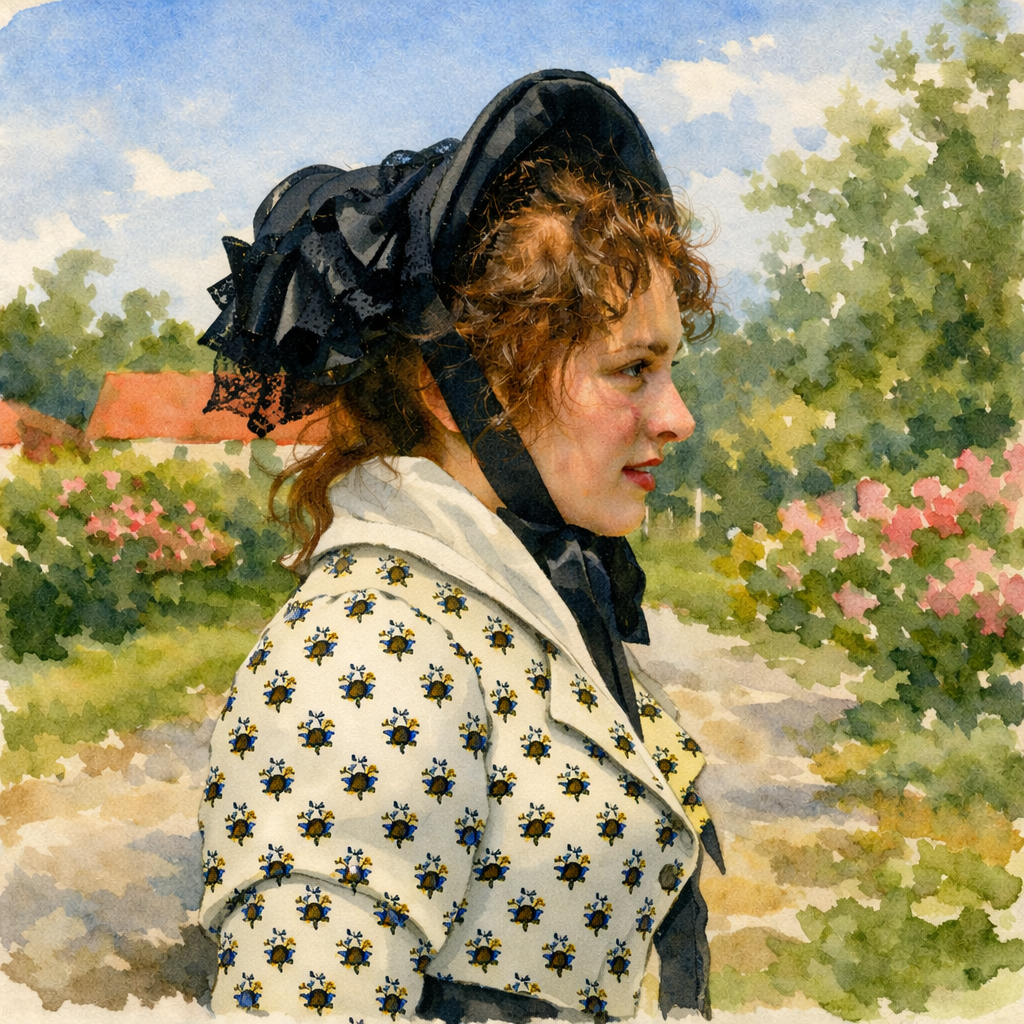
1810 Sara Elisabeth Moræa
1810 Sara Elisabeth Moræa
Design reference nr:
SKU:48800059
Couldn't load pickup availability
This historical cotton fabric design is inspired by an early 19th-century English dyer’s record book containing printed textile samples used for fashionable dress and menswear during the Regency period. The pattern features delicate stylised botanical motifs in blue, gold, brown, and black arranged across a soft light grey ground, creating a refined and elegant early 1800s appearance.
The original textile references were preserved in the workshop records of Thomas Ratcliffe, documenting historical printed cotton designs used in fashionable garments and textile production. The small repeating motif creates a highly versatile historical fabric especially suitable for Regency waistcoats, Spencer jackets, short jackets, historical vests, and elegant transitional fashion.
This reconstructed design works beautifully for historical menswear and tailored garments where the small motif creates texture and movement without overpowering the silhouette. The elegant colour palette also makes the fabric suitable for refined Regency womenswear and historical interiors.
Well suited for
– Regency waistcoats and historical vests
– Spencer jackets and short Regency jackets
– Transitional fashion c.1795–1820
– Historical menswear and tailoring projects
– Regency gowns and lightweight jackets
– Theatre costumes and reenactment clothing
– Historical interiors and decorative textile projects
– Doll clothes and miniature historical garments
Design & Historical Context
The original design inspiration comes from an English dyer’s record book associated with textile manufacturer Thomas Ratcliffe. Such record books documented printed cotton designs, dye recipes, and production references used throughout the late Georgian and Regency period.
Small-scale repeating botanical motifs like these became especially fashionable for waistcoats, short jackets, and elegant daywear where refined ornamentation and balanced colour combinations reflected the neoclassical taste of the early 19th century. The design adapts particularly well for tailored garments such as waistcoats and Spencer jackets, where the repeating pattern creates subtle texture and historical elegance.

Reference Person: Sara Elisabeth “Sara Lisa” Moraea von Linné (1716–1806) was a Swedish historical figure best known as the wife of Carl von Linné. Through the preservation and auctioning of her late husband’s scientific papers, she played an important role in the eventual creation of the Linnean Society of London. Her world reflects the intellectual and decorative culture connected to the elegant textile aesthetics of the Georgian and Regency era.