1780 Mary Somerville
1780 Mary Somerville
Design reference nr:
SKU:48790086
Couldn't load pickup availability
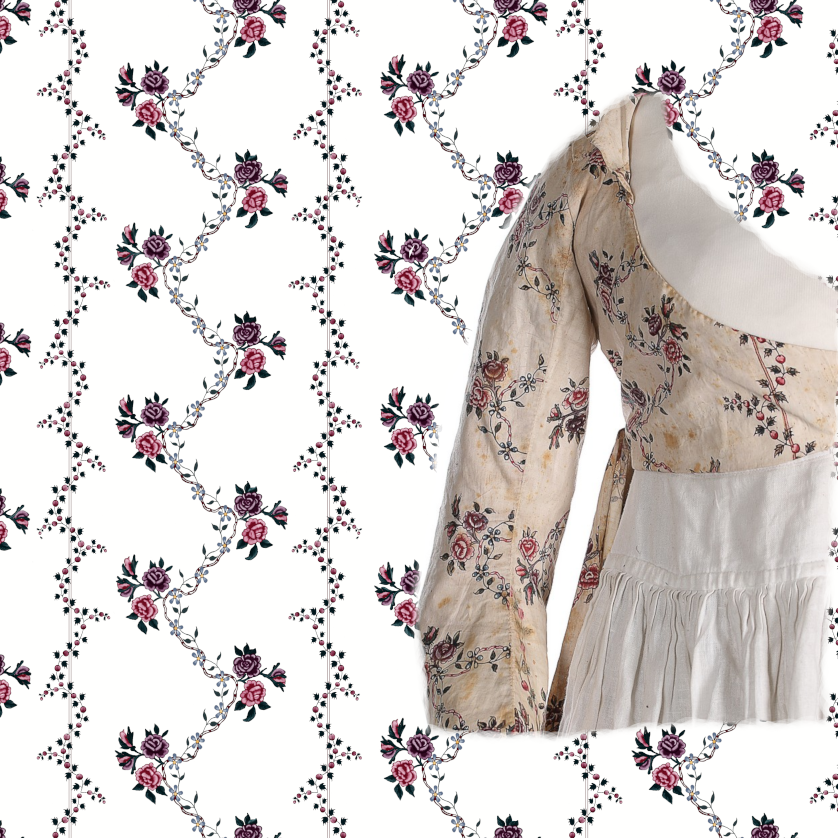
1780s Floral Cotton for Indienne Open Robe
Product Description
This delicate late 18th-century floral cotton is inspired by an Indienne open robe from the 1780s, later altered around 1790–1800. The design features fine stripes, berries, ribbon trails, and roses, giving the fabric a light and graceful character suitable for historical dressmaking.
The composition reflects the charm of printed Indian cottons used in European fashion during the late 18th century. Its floral trails and small berry motifs make it especially suitable for garments where softness, movement, and historical detail are important.
Well suited for
Indienne open robes, short gowns, Regency-style Spencer jackets, petticoats, bodices, and smaller historical sewing projects where a light floral striped cotton is desired.
Design & Historical Context
The original inspiration comes from an Indienne open robe dated to the 1780s and altered around 1790–1800. The original glazed cotton was block-printed with fine stripes, berries, ribbon trails, and roses, with narrow curved sleeves and later empire-line front closure panels.

Reference Person
Mary Somerville, in 1834 she became the first person to be described in print as a “scientist”. Born in 1780, she was a Scottish scientist, writer, and polymath. She studied mathematics and astronomy, and in 1835 she was elected together with Caroline Herschel as one of the first female Honorary Members of the Royal Astronomical Society.
When John Stuart Mill organised a major petition to Parliament for women’s right to vote, Somerville’s name was placed first — reflecting her intellectual influence and standing in society.
Mary Somerville. A portrait of Mary Somerville as a Young Woman by John Jackson (1778–1831). The portrait hangs in Somerville College, Oxford.