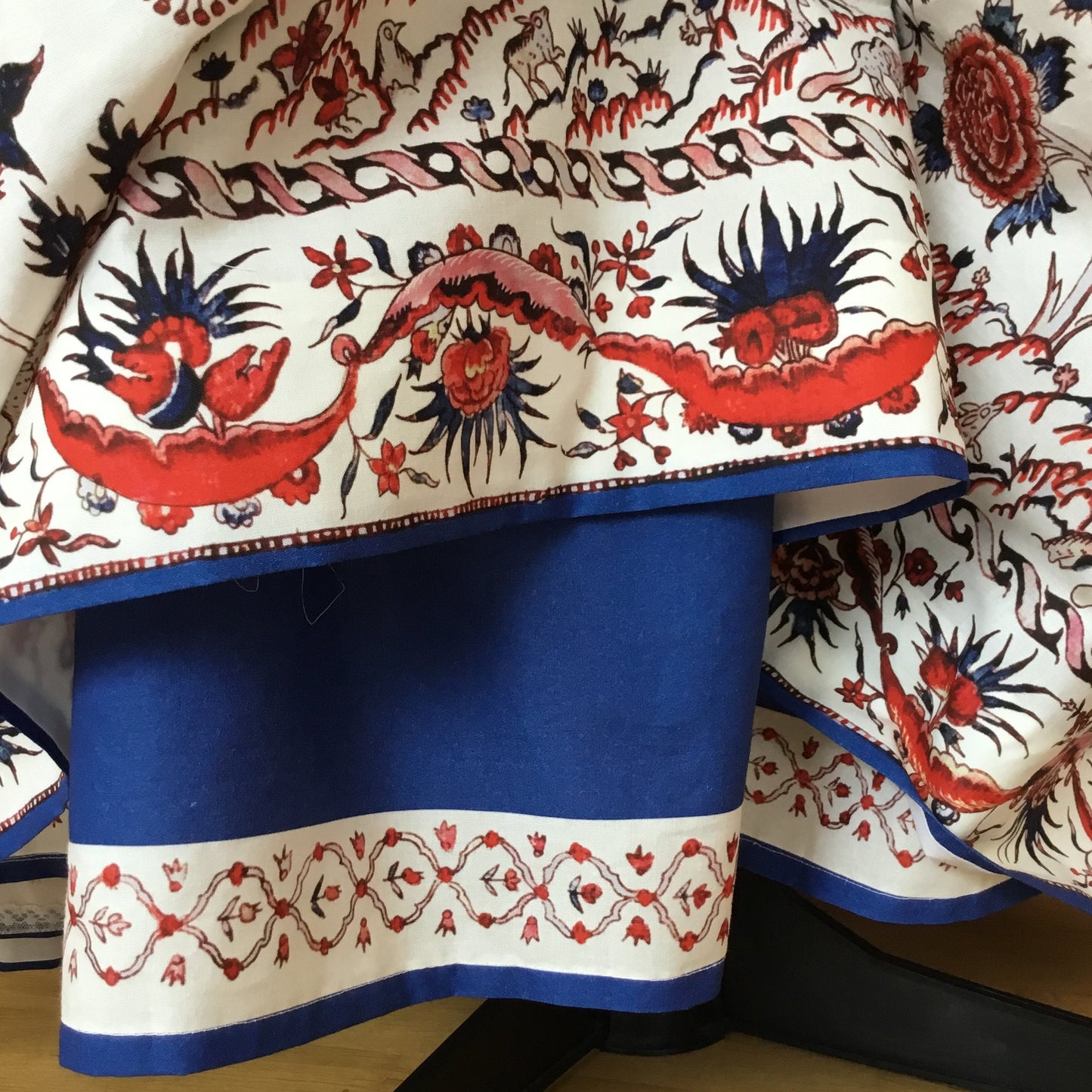
1750 Emilie Du Châtelet
1750 Emilie Du Châtelet
Design reference nr:
SKU:48790102
Couldn't load pickup availability
1730s–1750s Chintz Floral Cotton
Please note: The design is printed lengthwise. The minimum order quantity is 3 metres, providing enough fabric for a petticoat with a circumference of approximately 295 cm and a single seam on one side.
For a fuller petticoat, the circumference can be increased by ordering an additional 0.5 metre or 1.5 metres of fabric.
The main petticoat design measures approximately 120 cm from the waist to the hem. The remaining fabric above and below the main panel contains coordinating border patterns rather than being left blank. These sections can be used to make waist ties, decorative bands, or other matching details.
Product Description
This reconstructed chintz design is based on an original 18th-century textile fragment dated between 1730 and 1750. Developed for cotton cretonne, the pattern is particularly suitable for garments requiring length, movement, and visual continuity across larger pattern pieces.
Subtle irregularities have been intentionally preserved to reflect the character of historical block-printed textiles.
Well Suited For
Petticoats, skirts, banyans, jackets, robes battantes, underskirts, and other full-length garments.
Design & Historical Context
Chintz fabrics became highly desirable during the 18th century because of their detailed floral patterns, rich colours, and versatility in dressmaking. This design reflects the type of printed cotton used for petticoats and informal garments, where the placement and flow of the pattern contributed significantly to the finished appearance.

Émilie du Châtelet (1706–1749) was a philosopher, physicist, and mathematician, best known for her work on Newtonian mechanics and her intellectual collaboration with Voltaire.
Her life and work reflect the intellectual culture of the 18th century, a period in which science, literature, fashion, and refined material culture developed side by side.